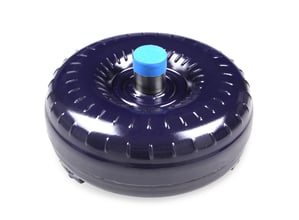
HOLESHOT 2400 TH400/350 2300-2500 RPM stall
10.75-inch bolt circle, 2300-2500 RPM stall
HoleShot 2400 for GM 1965 to 1991 TH400, 425, 375 and 1968 to 1981 TH350, 375B (not 350C) are for serious-minded performance enthusiasts and offer additional strength and durability features not found in our Tork Master or Traveler series of converters. The Holeshot converter is an excellent choice for vehicles with some performance engine modifications, particularly big cams that tend to reduce low-end power and torque. The higher stall speed of this converter will launch the car in a higher rpm range where more torque is readily available, resulting in quicker acceleration. Holeshot converters feature furnace brazed impeller fins and turbine, new precision alloy impeller hub and new heavy duty needle bearings. Other features include fully balanced and pressure tested by expert technicians. If your vehicle is equipped with a plate type nitrous system or supercharger, please refer to the Nitrous Holeshot line of converters. Notes: Stall speed listings are based on engines producing 230lb. ft. of torque at 2,500 rpm. More torque at 2,500 rpm will give you more stall speed, less torque at 2,500 rpm will give you less stall speed than the stall speed ratings indicated. Higher stall converters can generate more heat, so we highly recommend adding a transmission cooler. This converter is Not recommended for supercharged, plate-type nitrous oxide or trans-brake applications. The product images shown are for illustration purposes only and may not be an exact representation of the product. 10.75-inch bolt circle.
Precision Balanced on Certified Balance Equipment
Copper Furnace Brazed Impeller and Turbine
New Precision Alloy Steel Impeller Hub
Race Proven Technology & Quality
Heavy Duty Needle Bearings
Frequently Asked Questions
WHAT SHOULD I EXPECT FROM A PERFORMANCE TORQUE CONVERTER?
Strength and durability is an additional benefit if the converter is properly engineered. Furnace brazing is used to strengthen the converter internally for high performance, racing and heavy-duty applications.
WHAT IS STALL SPEED?
Stall speed numbers are listed primarily to rate the converter’s performance level. Typically, the number assigned, 2000, 2400, 3000 etc, lets you know what to expect from the converter. If a 2400 is selected, you should be able to flash stall the converter to about 2400 RPM. This should provide anywhere from 500 to 1000 more RPM to launch, or accelerate, the vehicle from a dead stop, as compared to the stock converter in the vehicle. This increase should substantially improve the acceleration capability of the vehicle. Lighter cars, 2800 lbs and under, typically stalls a little lower than the above mentioned numbers, therefore you should choose a converter with a higher stall number for optimum performance.
HOW DOES THE ENGINE’S CAMSHAFT AFFECT THE TORQUE CONVERTER’S PERFORMANCE?
The camshaft will affect the torque curve of the engine, which will affect the performance of the converter. For example if your 350 CID engine produces 230 lb.ft. of torque at 2400 rpm, a B&M HoleShot 2000 Converter will produce 2000 rpm stall speed. If you install a 268-degree cam into this engine you will raise the torque curve and at 2400 rpm your engine will produce less torque. Thus the 2000 stall converter will only stall at 1800 or less. However with this new cam the engine will make much more power above 3000 rpm. Keep in mind when the torque curve of the engine is raised you will need more stall speed in the converter to allow the vehicle to accelerate at low rpm (below 3000). A good rule of thumb for advertised cam durations up to 248 degrees, a 2000 or 2400 stall converter is a good choice. Advertised cam durations up to 268 degrees, a 2400 or 3000 stall converter is a good choice. Advertised cam durations over 272 degrees, a 3000 to 3600 stall converter is a must.

 Din varukorg är tom!